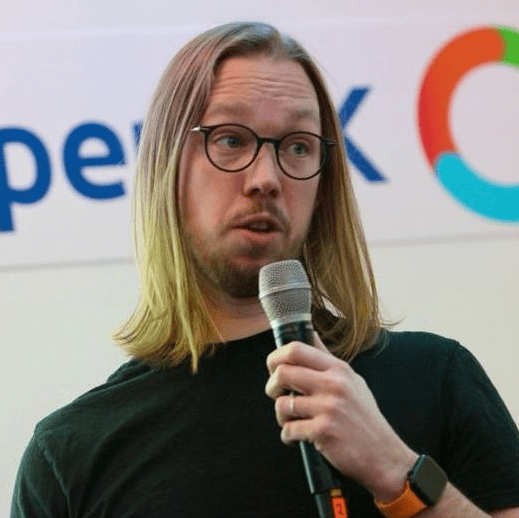
[00:01]
Viktor Petersson
Welcome back to another episode of Nerding Out With Viktor.
[00:04]
Viktor Petersson
Today I'm joined by David Pollak and today is going to be all about post quantum crypto.
[00:09]
Viktor Petersson
So nightmare fuel right there, David, for those not familiar with you.
[00:16]
Viktor Petersson
I mean, we've spoken a bit of time over the last few weeks, but you want to do a quick intro to the audience like, who's David?
[00:22]
Viktor Petersson
What should we know before we dive into all this terrifying stuff that we've been speaking about?
[00:27]
David Pollack
Hi, I'm David, otherwise known as dpp.
[00:31]
David Pollack
Been doing tech professionally for, I don't know, very long time.
[00:35]
David Pollack
47, 48 Years.
[00:38]
David Pollack
Got my start writing nuclear bomb damage estimation Systems for the U.S. federal Emergency Management Agency.
[00:44]
David Pollack
Yes, some idiot at FEMA gave a 14 year old a federal contract.
[00:49]
David Pollack
How did that go wrong?
[00:51]
David Pollack
What could go wrong?
[00:54]
Viktor Petersson
Oh, wow.
[00:56]
David Pollack
I did a bunch of Commodore 64 and Apple II software back in the day.
[01:04]
David Pollack
I'm a lawyer by training, but decided not to pursue the law.
[01:09]
David Pollack
Wrote a spreadsheet for Next computers.
[01:11]
David Pollack
It was the thing that Steve Jobs did in between Apple and Apple.
[01:15]
Viktor Petersson
Oh yeah, oh yeah.
[01:16]
David Pollack
And our product, you know, I had this three person company, Bootstrap funded and we beat Lotus out of the next market.
[01:24]
David Pollack
And Lotus was at the time the second largest software company in the world and they were the largest spreadsheet.
[01:32]
David Pollack
They were the spreadsheet.
[01:34]
Viktor Petersson
Yeah, yeah.
[01:35]
David Pollack
1, 2, 3 Was the spreadsheet and we beat Lotus out of the next market.
[01:40]
David Pollack
Wow.
[01:42]
David Pollack
Did a bunch of other stuff.
[01:43]
David Pollack
Did a startup, got acquired, moved out to San Francisco, started my San Francisco adventure.
[01:50]
David Pollack
Kids came along.
[01:51]
David Pollack
I decided to be the stay at home dad.
[01:54]
David Pollack
Did a little bit of consulting.
[01:56]
David Pollack
One of my clients was this little company with six engineers and scaling problems and they were, they had this Ruby on Rails stack.
[02:04]
David Pollack
And so I helped Twitter transition from Ruby on Rails to Scala.
[02:08]
David Pollack
Also wrote a Scala web framework called Lyft and helped the Twitter folks, designed their back end.
[02:18]
David Pollack
Did a bunch of other stuff.
[02:20]
David Pollack
Was at Cisco for a bunch of years working on the firewall.
[02:23]
David Pollack
And most recently I've been looking at how to use the same math, the same Merkle trees, et cetera that Git uses, but on post build artifacts.
[02:37]
David Pollack
So we think about Git and Merkle Trees and what's the hash of this commitment?
[02:43]
David Pollack
I think of that as a thing that we do with source code.
[02:48]
David Pollack
And thesis for Spice Labs is why not do that for host build artifacts too?
[02:55]
David Pollack
So we have a map of 18 billion nodes of hash values and graphs and that sort of thing for most of open source.
[03:05]
David Pollack
And we have tools that Will build mathematical graphs of proprietary software, compare the two.
[03:15]
David Pollack
What open source are you using?
[03:17]
David Pollack
And the way that we're applying that is around discovering how cryptography is used within applications.
[03:25]
David Pollack
So sorry for the sales pitch, but.
[03:27]
Viktor Petersson
No, not at all.
[03:29]
Viktor Petersson
I mean you have at least.
[03:32]
Viktor Petersson
Right.
[03:33]
Viktor Petersson
So you've been around for like, I mean there's so much to unpack there even before we dive into.
[03:48]
Viktor Petersson
But maybe before we go in, even there, like, let's go down memory lane.
[03:54]
Viktor Petersson
Like working Twitter in the early days that must have been quite adventure.
[03:58]
Viktor Petersson
Like that's.
[03:59]
Viktor Petersson
How was that engagement?
[04:01]
Viktor Petersson
Like, how does that look like?
[04:02]
Viktor Petersson
What happened?
[04:04]
Viktor Petersson
Trenches.
[04:06]
Viktor Petersson
Spill the.
[04:06]
Viktor Petersson
Spill the beans.
[04:09]
David Pollack
So imagine if your house is on fire.
[04:14]
Viktor Petersson
Right?
[04:14]
Viktor Petersson
Right.
[04:15]
David Pollack
And every time you put out a fire in one room, you have maybe 30 seconds before a fire pops up in another room.
[04:25]
David Pollack
How are you supposed to like clean your house when you've got fires in every room and no matter what you do, you can't put them out?
[04:35]
David Pollack
And that's what Twitter was back in 2008.
[04:40]
David Pollack
And yeah, this was before Amazon EC2 was a thing.
[04:47]
David Pollack
EC2 existed.
[04:48]
David Pollack
But if you wanted more than 20 machines, you had to provision them.
[04:52]
David Pollack
There was a lot of noisy neighbor problems on the virtualization platforms.
[04:57]
David Pollack
So Twitter quite literally was buying their own hardware.
[05:01]
David Pollack
So it was 90 days between the time they get a venture check and the time that they could install servers because they'd order the servers, they'd have to rack them.
[05:11]
David Pollack
This was all like, you know, caveman stuff.
[05:18]
David Pollack
I don't even remember.
[05:19]
David Pollack
I wasn't, I wasn't part of the racking and stacking team.
[05:22]
Viktor Petersson
Right.
[05:24]
David Pollack
And you know, the site would go down and it would be an all hands thing.
[05:30]
David Pollack
Well, what we had to do was we had to mitigate the problems.
[05:37]
David Pollack
And I, part of what I did there was discover the root cause of the fail whale, which was a very interesting intersection between the C based Ruby runtime and memcached.
[05:56]
David Pollack
So because they had a limited number of boxes, they co.
[06:01]
David Pollack
They co. Resided the web servers and the caches on the same box.
[06:07]
David Pollack
Which makes sense.
[06:08]
Viktor Petersson
Right?
[06:09]
Viktor Petersson
Right.
[06:12]
David Pollack
Well, there was a bug in mri, the maps runtime in the Ruby runtime that occasionally the garbage collector would start asking for extra slabs of memory from the os.
[06:27]
David Pollack
And if you've got a cache on the same box, you then had a problem where the cache would say, oh yeah, I'm a cache, I'll give you.
[06:38]
David Pollack
You want some memory, I'll just give you the memory.
[06:41]
David Pollack
So that would increase the number of cache misses and that would put pressure on the back end database.
[06:48]
David Pollack
And all of these things were like, you know, at 97% capacity.
[06:53]
David Pollack
Because every time Twitter added new physical boxes and could scale up, they literally got as many users as would make the site marginally usable.
[07:07]
David Pollack
This is a problem every startup wants.
[07:09]
David Pollack
It's like every time we grow, people love us so much.
[07:14]
Viktor Petersson
Right, Right.
[07:15]
Viktor Petersson
Textbook.
[07:16]
David Pollack
Yeah, textbook.
[07:17]
David Pollack
Or textbook fantasy.
[07:22]
David Pollack
So we had this problem where the cache invalidation would then put pressure on the back end database because you'd have more cache misses.
[07:33]
David Pollack
And once you had more cache misses, everything would slow down and that would put more pressure on everything.
[07:40]
David Pollack
And then once you brought the box back up, you then have a cash stampede because you had more caching.
[07:47]
David Pollack
You know, we all, you know, we now, what, 17 years later understand the patterns.
[07:56]
Viktor Petersson
Right.
[07:56]
David Pollack
But back then, a lot of these patterns were ones that we either discovered ourselves or there wasn't enough.
[08:04]
David Pollack
There weren't enough blogs out there to Google to find out what the heck was going on.
[08:10]
Viktor Petersson
Yeah.
[08:10]
Viktor Petersson
It's so interesting.
[08:15]
Viktor Petersson
The tech stacks look so different back then.
[08:17]
Viktor Petersson
I mean, not to say Rails, not a thing anymore.
[08:19]
Viktor Petersson
It certainly is.
[08:23]
Viktor Petersson
I mean, most stacks were running like PHP was a big thing back then.
[08:29]
Viktor Petersson
A lot of the company, like Facebook, Like those were like kind of the big cabs back then.
[08:39]
Viktor Petersson
Right.
[08:40]
David Pollack
Yeah.
[08:41]
David Pollack
And Java was a no go at Twitter because the engineers were either Ruby or Python people.
[08:47]
David Pollack
And just the ergonomics around Java and this was like pre Java 8 or around the Java 8 era.
[08:54]
David Pollack
So incredibly verbose language, no lambdas, none of the stuff that we now have in JavaScript, you know, and also no annotations.
[09:07]
David Pollack
So you couldn't basically just annotate a bunch of methods and have those turn into web routes.
[09:16]
David Pollack
So it was Java was a no go.
[09:19]
Viktor Petersson
Right.
[09:20]
David Pollack
And Ruby was Ruby and Rails was an incredibly expressive and powerful environment when you've got six engineers.
[09:30]
Viktor Petersson
Yeah.
[09:32]
David Pollack
And when you have six engineers that have a mind meld.
[09:35]
David Pollack
And they did, I mean, really, just freaking amazing engineers and amazing team cohesion.
[09:43]
David Pollack
And you know, it.
[09:46]
David Pollack
It got them to the right point.
[09:48]
Viktor Petersson
Yeah, yeah.
[09:51]
David Pollack
Anyway, so, yeah, problems with the runtime and one of the ways that we solved there were two things that we did to solve the problem or to stem the fire.
[10:03]
David Pollack
First thing that we did is we put a cron job in that would kill the Ruby processes, the rails processes every 15 minutes in a round robin fashion.
[10:20]
David Pollack
Yeah.
[10:21]
David Pollack
But, you know, it was the cost of cold starting a Rails instance versus losing your cache.
[10:28]
Viktor Petersson
Right, right.
[10:29]
David Pollack
The second thing is there was one endpoint, the public Timeline endpoint that received about 20% of the traffic.
[10:37]
David Pollack
And the thing that I did before south by Southwest 2008 was I rewrote that using Lyft and were able to basically reduce from, I think it was at the time, 15 boxes that were serving the public timeline to one.
[10:58]
Viktor Petersson
Oh, wow.
[11:00]
David Pollack
Yeah.
[11:01]
David Pollack
And so that first of all gave us more box physical boxes to serve the other endpoints.
[11:08]
David Pollack
And the second thing is a public timeline was not causing the pressure on the overall system because being able to write in, you know.
[11:19]
David Pollack
Right.
[11:19]
David Pollack
In a.
[11:20]
David Pollack
For a runtime that was faster and have multiple threads and be able to share data across the threads without having to go out to the cache, etcetera, Sped things up significantly.
[11:32]
David Pollack
So that's moved us from having the fire in every room every day to maybe having one fire a week, which gave us the ability to then sit down and start doing a rational design around the migration.
[11:48]
David Pollack
And you know, it's.
[11:52]
David Pollack
Sometimes you have to do the triage, you know, to stem the bleeding.
[11:57]
David Pollack
Yeah, you can figure out how to do the surgery.
[11:59]
David Pollack
And once again, the team back then was just such a freaking amazing team.
[12:07]
David Pollack
And yeah, we moved from firefighting mode to a mode where we could actually sit down and think about the problems.
[12:16]
David Pollack
And the team put together a really nice message oriented design.
[12:26]
David Pollack
And the rest is kind of history.
[12:30]
David Pollack
And you know, the way I put it is the design the team came up with that started the evolution of the kernel of the design.
[12:40]
Viktor Petersson
Yeah.
[12:41]
David Pollack
Survived Elon Musk and his, oh, let's just take a chainsaw this stuff.
[12:45]
Viktor Petersson
Right.
[12:46]
David Pollack
The fact that the system is still so amazingly resilient.
[12:50]
Viktor Petersson
Right, right.
[12:51]
David Pollack
Is a testament to the team that put the original design together.
[12:56]
David Pollack
And then the way that Twitter evolved, the engineering team and then their public trust team and the security team to like really care about the structure of what Twitter was building.
[13:13]
David Pollack
And you know, I think to a great degree, the doing things ethically and right kneecapped Twitter from a revenue standpoint.
[13:22]
David Pollack
You know, Mark Zuckerberg famously called Twitter, quote, a bunch of clowns that drove a clown car into a gold mine.
[13:31]
David Pollack
And I think of it exactly the opposite.
[13:33]
David Pollack
I think it was a bunch of people who really cared about doing the right thing and creating a public forum.
[13:40]
David Pollack
And whether it was investing in the technology and the people that built the technology, or investing early in security and trust, those things were done correctly and ethically.
[13:55]
David Pollack
Yeah.
[13:55]
David Pollack
You know, Twitter didn't become a 200 billion dollar company or a trillion dollar company, but it did become a company that fundamentally altered the way that humans had conversations.
[14:09]
Viktor Petersson
Yeah, yeah.
[14:09]
Viktor Petersson
I mean now, I mean, obviously with mustard and everything, like distributed models and all those things have happened since.
[14:17]
Viktor Petersson
But like, it is true, like they.
[14:18]
Viktor Petersson
They definitely had a very big.
[14:20]
Viktor Petersson
And they did some really cool stuff.
[14:21]
Viktor Petersson
I remember back in the day, the Wilson using protocol for like deploying software updates internally, something along those lines.
[14:35]
David Pollack
That was after my time.
[14:37]
David Pollack
But yeah, I mean, the thing is that when you have a stable foundation, you can then explore and when you have the social safety or the psychological safety on the engineering team to be able to try things, then you try things and sometimes they work and once again push boundaries.
[14:57]
David Pollack
When you have a human structure that allows you to push boundaries.
[15:04]
Viktor Petersson
No, no, it's pretty impressive.
[15:06]
Viktor Petersson
I mean.
[15:08]
Viktor Petersson
Yeah.
[15:09]
Viktor Petersson
To be able to run the same stack this many years later.
[15:11]
Viktor Petersson
I mean, that's very impressive indeed.
[15:14]
Viktor Petersson
Yes.
[15:15]
Viktor Petersson
Super cool.
[15:17]
Viktor Petersson
I can't turn now to the main topic of today, what we're going to talk about, which is post quantum crypto.
[15:24]
Viktor Petersson
We were chatting back in Moki Gras a few weeks ago in London and we talked about that, but eventually our conversations shifted over to post quantum.
[15:34]
Viktor Petersson
And it was a rather timely conversation because the same week I believe Google published their updated paper on breaking quantum breaking encryption using quantum.
[15:47]
Viktor Petersson
Maybe for those audience who are not.
[15:52]
Viktor Petersson
Who even know what this means, because this sounds like a word salad to a lot of people, even in engineering.
[15:58]
Viktor Petersson
Like, you need to be kind of like it's a bit of a.
[16:01]
Viktor Petersson
Let's take a step back.
[16:02]
Viktor Petersson
What does it mean?
[16:03]
Viktor Petersson
What does post quantum crypto mean?
[16:05]
Viktor Petersson
What are the implications?
[16:06]
Viktor Petersson
Why should people care?
[16:09]
David Pollack
So let me start with the implications and why people should care.
[16:13]
David Pollack
We have, you know, over the last 20, 25 years, built this beautiful thing that has connected our entire species, or at least 70% of our species together.
[16:28]
David Pollack
Yeah, we're having a call or a conversation between the United States and London or, I'm sorry, Bristol.
[16:37]
Viktor Petersson
Yeah, yeah, close enough.
[16:44]
David Pollack
We're having this trans.
[16:45]
David Pollack
Transatlantic conversation.
[16:47]
Viktor Petersson
Yeah.
[16:48]
David Pollack
Casually drinking coffee, talking about stuff.
[16:52]
David Pollack
I mean, I got a cat in my lap.
[16:53]
David Pollack
How, you know, back in the day, who.
[16:56]
David Pollack
You know, if you had a transatlantic call, people would get dressed up in suits even though they couldn't see each other.
[17:02]
Viktor Petersson
Right, right.
[17:03]
David Pollack
It was important.
[17:04]
David Pollack
It cost money.
[17:05]
David Pollack
And now like, hey, yeah.
[17:07]
David Pollack
How many people WhatsApp each other around the world every day, Whether it's text or voice or whatever.
[17:15]
David Pollack
We're now a connected species.
[17:16]
David Pollack
And getting back to the Twitter thing, part of what Twitter did was create this global conversation we have through the history of Building things on the Internet with one exception, always put adoption way before security.
[17:36]
David Pollack
And the one exception was tls, which sits on top of two different encryption protocols and a handshake protocol.
[17:46]
David Pollack
The two encryption protocols are their RSA or elliptic curve.
[17:51]
David Pollack
And the handshake is Diffie Hellman.
[17:55]
David Pollack
I'm sorry, Diffie Hellman.
[17:59]
David Pollack
We trust that.
[18:01]
David Pollack
We trust what, you know, when we use our mobile to talk to our bank, we trust that we can do that without adversaries getting in the way.
[18:12]
David Pollack
You don't think about North Korean hackers draining your bank account just because you use your mobile to check your balance.
[18:19]
David Pollack
That's because of encryption.
[18:21]
David Pollack
That is a level of trust, inherent level of trust that we have in our communications and in our interactions with other systems.
[18:34]
David Pollack
And it has worked very well.
[18:37]
David Pollack
So what is at stake here is the trust that we all implicitly have in the communications and also in the documents.
[18:48]
David Pollack
And the documents are an important part of this.
[18:51]
David Pollack
So if you use DocuSign, you sign something, you know, using your.
[18:56]
David Pollack
And get a PDF.
[18:58]
David Pollack
That PDF is digitally signed.
[19:02]
David Pollack
And that means that your signature and the information about your signature can't be repudiated.
[19:11]
David Pollack
Your signature can't be copied onto a document that says something else that is also digitally signed.
[19:19]
David Pollack
The U.S. department of justice uses digital signatures for chain of custody in their criminal cases.
[19:29]
David Pollack
Banks, when they do reconciliation at night, you know, HSBC might have 200,000 transactions with bank of America every day, but the net amount of money that's moved between the two is a lot smaller than the NET of the 200,000 or the gross addition of the 200,000 transactions.
[19:52]
David Pollack
So every night or periodically they do reconciliation, saying, hey, you know, there's, you know, $2 million that I have a net of $2 million that one owes the other.
[20:03]
David Pollack
That stuff is digitally signed.
[20:05]
David Pollack
So there's a record of who said what, who transferred what to whom, and when Bitcoin is built.
[20:13]
David Pollack
And, you know, the cryptocurrencies are quite literally built on cryptography.
[20:18]
David Pollack
And we trust those transactions because of proof of work, proof of stake, you know, the various different cryptographic proofs.
[20:27]
David Pollack
And we protect our, the private key for our wallets.
[20:33]
David Pollack
Some people do it at gunpoint.
[20:35]
David Pollack
You know, there have been kidnappings where people have been kidnapped to get the private, or to get the password of private key to their wallets.
[20:44]
David Pollack
Yeah, these things are all huge.
[20:50]
David Pollack
Now.
[20:53]
David Pollack
What happens when that trust is eroded?
[20:59]
David Pollack
It is a societal and seismic impact.
[21:03]
David Pollack
And because these trust mechanisms are built into everything that we do, they're almost invisible to us.
[21:12]
David Pollack
It's very much like, you know, the electricity that comes to your house or the plumbing, the water that comes in, the sewage that goes out.
[21:21]
David Pollack
We know that it happens, but we take it so much for granted.
[21:25]
David Pollack
It is invisible to us.
[21:27]
David Pollack
And, you know, we don't think about a world without that.
[21:31]
Viktor Petersson
Yeah.
[21:33]
David Pollack
So that's what's at stake.
[21:35]
David Pollack
It's that trust.
[21:37]
David Pollack
It's the trust that we've built up with technology over 20 plus years now.
[21:44]
David Pollack
You want me to go into the.
[21:45]
Viktor Petersson
Yeah, I think you're painting a very good picture here of why this actually matters, because I think it's easy to get too academic about these things and not see the real world implications of why it matters.
[22:02]
David Pollack
So the underlying how is the problem.
[22:09]
David Pollack
The way that both RSA encryption and elliptic curve encryption work is you have two very large prime numbers.
[22:22]
David Pollack
You multiply them together and you give them the product.
[22:26]
David Pollack
To me, the two prime numbers make up your private key and the product of those two prime numbers.
[22:34]
David Pollack
And look, you go through some machinations, but this is the fundamental math behind it.
[22:39]
David Pollack
The product of those two prime numbers is something that can be used to encrypt data that can only be decrypted if you know what the two prime numbers are.
[22:52]
Viktor Petersson
Right, right.
[22:55]
David Pollack
The computational cost of doing what's called prime factorization of numbers of that size is computationally difficult.
[23:09]
David Pollack
So using our existing computers, it would take until the heat death of the universe, even with like GPUs and everything else.
[23:17]
Viktor Petersson
Right, right, right.
[23:19]
David Pollack
To discover the two prime numbers that make up the public key.
[23:26]
David Pollack
From the public key.
[23:27]
Viktor Petersson
Right.
[23:28]
Viktor Petersson
Because you basically have this brute force and guess over and over and over again until you've derived the right conclusion.
[23:37]
David Pollack
Quantum computers, because.
[23:39]
David Pollack
So let me talk a little bit about quantum mechanics because it is an absolutely irrational branch of physics that.
[23:53]
David Pollack
It's irrational from our standpoint, but it is the basis of our entire universe, our entire existence, which is.
[24:04]
David Pollack
I'll use the Schrodinger's cat metaphor.
[24:09]
David Pollack
Schrodinger's cat is a thought exercise where you have a cat in a box.
[24:18]
David Pollack
The box has a vial of poison in it.
[24:22]
David Pollack
And the vial of poison can be cracked or not cracked, depending on whether a single atom has a particular attribute, a particular spin.
[24:35]
David Pollack
Spin is just a mathematical term.
[24:37]
David Pollack
It's, you know, there's colors and spins and all kinds of crazy things that the physicists, who apparently took a lot of acid thought up.
[24:47]
David Pollack
Anyway.
[24:48]
David Pollack
Sorry, my dad was a physicist.
[24:51]
David Pollack
He did not touch acid.
[24:52]
David Pollack
But that's entirely but you don't know whether the cat is both alive and dead at the same time until it's observed.
[25:07]
David Pollack
Until you observe what that state.
[25:10]
David Pollack
The state of that atom is.
[25:13]
David Pollack
The state of the atom is in both positions.
[25:15]
David Pollack
It's called superposition.
[25:17]
Viktor Petersson
Right, Right.
[25:19]
David Pollack
Back in the 90s, there was this guy named Shore who figured out how to use quantum superpositions to create an algorithm that could do prime factorization.
[25:34]
David Pollack
So something that would take our classic computers hundreds of billions of years to solve using Shor's algorithm will take milliseconds, or depending on the quantum computer, maybe a few seconds or a few minutes.
[25:50]
David Pollack
But it's quite a scale time, quite the delta.
[25:56]
David Pollack
And the.
[25:57]
David Pollack
The trick is you don't observe the intermediate representations until the algorithm is finished.
[26:06]
David Pollack
And when you observe the output, that's when the superpositions collapse into the right answer.
[26:12]
David Pollack
Now, I'm simplifying the hell out of it.
[26:14]
Viktor Petersson
Yeah, I. I don't quite understand that.
[26:16]
Viktor Petersson
But, yes, I think I can roughly.
[26:17]
David Pollack
Get the sense of it just nobody, or I shouldn't say nobody.
[26:24]
David Pollack
The number of people who actually understand quantum mechanics is very limited because it is incredibly counterintuitive that something doesn't happen until a human observes it.
[26:37]
Viktor Petersson
Right?
[26:37]
Viktor Petersson
Right.
[26:39]
David Pollack
So all of a sudden, we can do this prime factorization.
[26:44]
David Pollack
And the question is, how many quantum bits or qubits do you need to be able to do prime factorization of large numbers?
[26:56]
David Pollack
And it turns out there's a formula for this, and you need some multiple of the number of bits.
[27:04]
David Pollack
So if you have RSA 4096, it's 4096 bits.
[27:09]
David Pollack
So how many qubits do you need?
[27:10]
David Pollack
I think it's about 12 or 15,000.
[27:13]
David Pollack
Elliptic curve uses 256 bits.
[27:16]
David Pollack
So how many qubits do you need?
[27:18]
David Pollack
I think it's like 1200, 1500 cubits.
[27:22]
David Pollack
And there is a huge engineering problem around doing what's called coherence across the number of qubits, across the number of atoms or other quantum material to do the calculation.
[27:41]
David Pollack
So there is just a ton of engineering.
[27:43]
David Pollack
And, you know, there are a couple of different ways of doing this.
[27:46]
David Pollack
One is called, I think, free ion.
[27:48]
David Pollack
The other one is superconductor.
[27:51]
David Pollack
My son's a physics major.
[27:52]
David Pollack
He explained it to me once over dinner, and I promptly forgot it.
[27:56]
David Pollack
But there was a paper out of China, I don't know, a year or two back, that where they broke 50 bit.
[28:05]
David Pollack
They actually demonstrated with one of their quantum computers, they were able to break 50 bit RSI.
[28:13]
David Pollack
So the.
[28:15]
David Pollack
When Will classic encryption be broken?
[28:17]
David Pollack
Question has always been the same.
[28:20]
David Pollack
Answer is when are we going to have fusion power?
[28:23]
David Pollack
Which is it's always 10 years away.
[28:25]
Viktor Petersson
Right, right, right.
[28:26]
David Pollack
Except we're actually solving a lot of the engineering problems and Google came out and said 2029 is when elliptic curve will be breakable with quantum computers and that's going to allow forging of Bitcoin transactions.
[28:48]
Viktor Petersson
That is so terrifying that it's hard to even comprehend because the ramifications of that are so massive.
[28:56]
Viktor Petersson
Because historically it's just been equation.
[28:59]
Viktor Petersson
Like when people talk about breaking encryption previously, Like 2024 used 2048 and used bump, you get slower operations.
[29:15]
Viktor Petersson
It doesn't really matter at the end of the day.
[29:17]
Viktor Petersson
Right.
[29:17]
Viktor Petersson
But now it's just a question of like it doesn't matter anymore.
[29:24]
David Pollack
Yeah.
[29:25]
David Pollack
And so there are a series of cryptography algorithms that are called lattice based cryptography.
[29:35]
David Pollack
They use more bits and they require more computation.
[29:40]
David Pollack
And the sub parts of the computation are not built into hardware.
[29:46]
David Pollack
So most of our processors, you know, most modern processors have for example, SHA2 that a lot of the pieces of doing SHA2 hashing, you know, SHA256 built into the hardware.
[30:01]
Viktor Petersson
Right, right.
[30:02]
David Pollack
So it's not a software.
[30:03]
David Pollack
The software loops are much faster.
[30:06]
Viktor Petersson
Right.
[30:07]
David Pollack
A lot of encryption also has hardware support.
[30:10]
David Pollack
The lattice based encryption does not.
[30:12]
David Pollack
And the key lengths are larger and the computation required is heftier.
[30:19]
David Pollack
So yeah, the new algorithms were not necessarily thought of as we want these now for a bunch of reasons.
[30:29]
David Pollack
I mean, you know, if you've got a fast motorcycle, are you going to trade that for a tractor?
[30:38]
Viktor Petersson
Yeah, yeah, exactly.
[30:39]
Viktor Petersson
Because it's so such a core building block in anything we do today.
[30:46]
David Pollack
Right.
[30:47]
Viktor Petersson
We take this for granted fully, that it's just going to be encrypted.
[30:52]
Viktor Petersson
We know the latency of doing encryptions, it doesn't really matter.
[30:58]
Viktor Petersson
Right.
[31:06]
Viktor Petersson
Normally, like it doesn't matter for both companies.
[31:08]
Viktor Petersson
Right, yeah.
[31:10]
David Pollack
And so the other thing that you alluded to in the past a few minutes ago was the fact that we do discover flaws in the algorithms.
[31:24]
David Pollack
So we have had relatively stable algorithms and changed bit size for the public key encryption for RSA analytic curve for we move from DES to triple DES to AES for symmetric key encryption, you know, but that has evolved and AES seems to be.
[31:49]
David Pollack
Nobody's broken it yet.
[31:50]
David Pollack
Nobody's found weaknesses in it yet to.
[31:53]
Viktor Petersson
Our knowledge, which I think is an important caveat.
[31:58]
David Pollack
Well, so the Google paper that came out is the stuff that we're Seeing above the waterline to.
[32:05]
Viktor Petersson
That's what I was like.
[32:08]
Viktor Petersson
We know he's probably five years behind.
[32:11]
David Pollack
Yes.
[32:12]
David Pollack
And the question is, what do governments with substantial budgets and substantial ability to keep things secret, what do they have?
[32:26]
David Pollack
And you know, once again, going back to my conversation with my son, he was talking about how hard would it be to set up a big enough quantum computer to solve these problems in a way that is, that can be hidden budgetarily.
[32:48]
David Pollack
So, you know, if you have a 50 billion dollar quantum computer and it is, you know, requires a lot of cooling and a whole bunch of other stuff, hiding that is hard.
[33:03]
Viktor Petersson
So the constraint becomes hiding in the budget, not the fiscal constraint.
[33:08]
Viktor Petersson
Building it.
[33:09]
David Pollack
Well, it's hiding it in the budget.
[33:11]
David Pollack
Building it in a way that it's not going to be seen by spy satellites.
[33:16]
Viktor Petersson
So if you have a lot of like detailed data, sensors.
[33:21]
Viktor Petersson
Right, right.
[33:22]
David Pollack
Yeah.
[33:23]
David Pollack
But then you say, okay, why is, yeah, why is.
[33:26]
David Pollack
I'll, I'll pick on Canada because the folks from Talos Group at Cisco that I used to work with always, you know, called Canada the adversary, because Canada is never the adversary.
[33:38]
David Pollack
Well, so, you know, if Canada all of a sudden started doing a lot of excavation of mountains, so they were hiding something, everybody be like, okay, what are they hiding?
[33:52]
Viktor Petersson
Yeah, I'll be like, what World War II era building something new.
[34:01]
David Pollack
Right.
[34:01]
David Pollack
Yeah, well, that's, I think that is to a great degree a Western mentality.
[34:10]
David Pollack
So, yes, in Europe, North America and Russia, there is a lot of stuff to repurpose.
[34:18]
David Pollack
What about China?
[34:19]
Viktor Petersson
True.
[34:21]
David Pollack
And you know, how do you trunk in enough power to power these things?
[34:29]
David Pollack
So one of Daniel's suppositions is that quantum computers using the free ions are much lower cost and much lower power than the superconducting ones.
[34:45]
Viktor Petersson
Interesting.
[34:46]
David Pollack
But the challenge with the free ion quantum computers, and you know, he said, look, you could probably build it in university, the basement of a university lab, probably for under $100 million.
[34:58]
David Pollack
And you know, $100 million is a lot of money.
[35:01]
David Pollack
But you.
[35:02]
Viktor Petersson
Not for these things.
[35:03]
Viktor Petersson
Right, right.
[35:04]
David Pollack
Not for these things.
[35:05]
David Pollack
And also think of thinking about, you know, budgets of large Western countries.
[35:12]
David Pollack
I mean, Germany just passed a bill where they're going to spend 500 million euros a year on carbon capture.
[35:20]
David Pollack
Yeah, okay, so they're doing carbon capture at, you know, big scale.
[35:25]
David Pollack
Could they hide 50 million euros of that to do some quantum stuff?
[35:31]
David Pollack
Yeah, sure.
[35:32]
Viktor Petersson
Yeah.
[35:34]
David Pollack
So the techno, the quantum technology being used is part of the equation.
[35:39]
David Pollack
How you hide it is part of the equation and whether you have it as part of the equation and this.
[35:47]
David Pollack
Well, let's just talk.
[35:50]
David Pollack
Let's circle back to Bletchley Park.
[35:53]
David Pollack
Yeah, go ahead with your question.
[35:54]
Viktor Petersson
No, no, I was gonna say, because one of the things.
[36:02]
Viktor Petersson
Purists to my knowledge consider that there are no quantum computers.
[36:07]
Viktor Petersson
Yeah, right.
[36:08]
Viktor Petersson
There are quasi quantum computers.
[36:11]
David Pollack
Right.
[36:12]
Viktor Petersson
That is my understanding of it, how much that is true.
[36:15]
Viktor Petersson
What is a real quantum computer versus non real quantum computer?
[36:21]
David Pollack
Look, my son's an undergrad at Boston University, which is not mit, it's not Harvard, it's not Stanford, and he built, I think a 4 or 6 bit qubit quantum computer as part of one of his lab exercises.
[36:41]
Viktor Petersson
I just remember.
[36:42]
Viktor Petersson
Yeah, Because I remember back when a friend of mine was over at Stanford Research doing something there, and I remember that some new quantum computer, AI computer, tried to donate one of their quantum computers to Stanford cst and they're like, no, we don't want it.
[37:00]
Viktor Petersson
It's not a real quantum computer.
[37:02]
Viktor Petersson
But that's quite a few years ago.
[37:04]
David Pollack
Yeah, I mean, it is.
[37:06]
David Pollack
You know, think of it this way.
[37:11]
David Pollack
The quantum computers that are necessary to break encryption are similar to the amount of computing that we have in our iPhones or our Android phones.
[37:23]
David Pollack
This is not a direct comparison.
[37:25]
David Pollack
It is comparison to going out to the store and buying two or three hundred NAND gates and wiring them together into a very simple computer.
[37:36]
David Pollack
So, yes, we can buy a couple hundred NAND gates, wire them together into a simple computer that is, I don't know, million times slower than our iPhone, 100 million times slower.
[37:46]
David Pollack
I don't know, some vast number of times slower.
[37:52]
David Pollack
Does that mean that.
[37:54]
David Pollack
Yeah, it means that building a computer out of NAND gates is a possibility.
[37:59]
David Pollack
And it becomes an engineering thing to say, how many transistors or how many NAND gates can you wire together and manage at the same time?
[38:09]
David Pollack
Which is the engineering challenge, not the core.
[38:13]
David Pollack
Can you build a computer challenge?
[38:16]
Viktor Petersson
Okay, okay, fair enough.
[38:17]
Viktor Petersson
Yeah.
[38:17]
Viktor Petersson
Okay, okay, fair enough.
[38:18]
Viktor Petersson
Yeah.
[38:20]
David Pollack
So anyway, The issue, the Bletchley park issue is During World War II, we could break German encryption.
[38:34]
David Pollack
When I say we, I mean the Allies.
[38:36]
David Pollack
And I figure, you know, you're in one Allied country, I'm in another.
[38:40]
David Pollack
So we.
[38:41]
Viktor Petersson
Yes,.
[38:45]
David Pollack
And we kept that secret.
[38:48]
David Pollack
And there are some documented cases, you know, if you go tour of Bletchley park, there's some documented cases where they knew attacks were going to take place and they did not warn the Allied commanders that the attacks were going to take place because it would have revealed too much about our ability to break encryption.
[39:10]
David Pollack
So the.
[39:12]
David Pollack
How powerful are things?
[39:14]
David Pollack
What.
[39:14]
David Pollack
What's below the waterline is quite literally a state secret.
[39:20]
David Pollack
Because if we.
[39:21]
David Pollack
If the US could break encryption and we could listen in on an adversary's conversations, we don't really want the adversaries knowing that we can listen in on their conversations.
[39:34]
Viktor Petersson
Yeah, yeah.
[39:35]
Viktor Petersson
I mean, I guess.
[39:36]
Viktor Petersson
I guess this kind of takes us to the Snowden papers, right, what were revealed back in those data dumps.
[39:46]
Viktor Petersson
I forgot the exact phrase that was used, but it's like capturing a harvest later, I think it's called.
[39:50]
David Pollack
Right, yeah.
[39:51]
Viktor Petersson
And the concept being that, yeah, we cannot decrypt this data today, but there will come a point in the future where we can.
[40:00]
Viktor Petersson
So let's just capture everything.
[40:03]
David Pollack
And, yeah, you'll see occasional BGP routes that send a substantial part of U. S. Internet traffic through China.
[40:12]
David Pollack
I wonder why that's happening.
[40:14]
Viktor Petersson
Right?
[40:14]
David Pollack
I don't.
[40:15]
David Pollack
I'm being sarcastic.
[40:19]
David Pollack
The.
[40:20]
David Pollack
The harvest now, decrypt later problem is a problem, and I agree with that.
[40:24]
David Pollack
But I actually think the forgery problem is a bigger one.
[40:26]
Viktor Petersson
Yeah.
[40:27]
David Pollack
Because the breaking of trust and the draining of bitcoin wallets and the throwing into doubt the trust pillars that we have are the things that erode our social fabric.
[40:43]
David Pollack
And a lot of western society, a lot of democratic societies, are built on trust.
[40:49]
David Pollack
And when you erode that trust, when normal people stop believing in the institutions or have reasons to doubt the institutions, that leads to an erosion of power.
[41:07]
David Pollack
Because our power, or soft power, comes from cohesion.
[41:12]
David Pollack
And breaking and breaching the trust damages that cohesion.
[41:17]
Viktor Petersson
Yeah.
[41:18]
Viktor Petersson
Yeah.
[41:18]
Viktor Petersson
I mean, this really is like a massive extension of what we've seen in many countries where, like, there is little trust in public news sources, for instance, or public not coming out of the government.
[41:30]
Viktor Petersson
Right.
[41:31]
Viktor Petersson
And this is kind of an extension of that.
[41:33]
Viktor Petersson
You can see this firsthand in.
[41:34]
Viktor Petersson
In countries, I mean, where they don't trust any news sources.
[41:41]
Viktor Petersson
So what happens, that vacuum is then filled by Facebook and like, these WhatsApp groups.
[41:47]
Viktor Petersson
Like, you've seen that one, Pakistan.
[41:51]
Viktor Petersson
You see that lot.
[41:51]
Viktor Petersson
Like, you see a lot in.
[41:54]
Viktor Petersson
You see this a lot.
[41:55]
Viktor Petersson
Right.
[41:55]
Viktor Petersson
But this is like, this is not like fake news.
[41:58]
Viktor Petersson
This is like the fabric of society.
[42:00]
Viktor Petersson
It's like so many levels deeper to road.
[42:04]
Viktor Petersson
Right.
[42:05]
David Pollack
Yeah.
[42:09]
David Pollack
So we have, what, three years, maybe four years to fix the problem.
[42:18]
Viktor Petersson
That are still running mainframes.
[42:22]
Viktor Petersson
So just put it back to a fast.
[42:24]
Viktor Petersson
Right.
[42:25]
David Pollack
Yeah.
[42:26]
David Pollack
And you know that.
[42:28]
David Pollack
That talking about mainframes is actually interesting.
[42:31]
David Pollack
Because a lot of people have been analogizing the problem that we have now to the Y2K problem.
[42:40]
Viktor Petersson
Yeah, yeah,.
[42:42]
David Pollack
Right.
[42:43]
David Pollack
And so, but mainframes, I think were a critical part of being able to solve the Y2K problem.
[42:49]
David Pollack
Because at the time the chief information officer who had to certify that all of the systems would work on January 1, 2000, could go to the CFO of a company and say, give me a list of all of our mainframe leases.
[43:07]
David Pollack
That would give them a list, effectively the starting point for saying, who's got software on these?
[43:13]
David Pollack
What software are we running?
[43:16]
David Pollack
And that was a bounded list.
[43:18]
Viktor Petersson
Yeah,.
[43:22]
David Pollack
Big bank, maybe two, 300 mainframes.
[43:25]
David Pollack
I mean, you know, these things were millions of dollars a year in lease fees.
[43:30]
Viktor Petersson
Yeah, yeah.
[43:32]
David Pollack
Now we're pushing new versions of software continuously.
[43:41]
David Pollack
We have millions and millions of servers at Amazon or AWS and Google Cloud and name your cloud provider.
[43:53]
David Pollack
How do we even inventory where this stuff where we're using cryptography, we can look at the TLS handshakes for network traffic and make sure that they're TLS 1.3, make sure that the right algorithms are being offered and accepted.
[44:10]
David Pollack
And Cisco and Palo Alto Networks and the other firewall vendors all have various different firewall rules and other DPI and stuff.
[44:21]
David Pollack
Yeah, yeah.
[44:22]
David Pollack
So that stuff is a bounded problem.
[44:25]
David Pollack
So the harvest now decrypt later is a bounded problem because it's mostly public Internet traffic, it's mostly inspectable through firewalls and it's also proxyable.
[44:38]
David Pollack
So if you basically have some old, you know, 32 bit Solaris system that can't be upgraded to use the lattice based algorithms, you can put a proxy in front of it to do the translation, you know, to do the TLS handshaking and turn that from TLS 1:1 to TLS 13.
[44:59]
David Pollack
And so those are solvable problems.
[45:04]
David Pollack
But the where are we digitally signing things?
[45:08]
David Pollack
Where are we encrypting at rest using public keys that can be anywhere in any of our software stacks.
[45:18]
Viktor Petersson
Yeah, that's.
[45:19]
Viktor Petersson
I mean, just a slight tangent, but I anecdotally heard this from a bank in the uk.
[45:27]
Viktor Petersson
It's related to mainframes.
[45:30]
Viktor Petersson
It's just a funny side note, but one of those big acquisitions going around and merging between the different banks in the uk.
[45:36]
Viktor Petersson
I forgot the exact names, but I heard from somebody working there.
[45:39]
Viktor Petersson
And basically after acquisition, the one company, one bank swallowed another and they were consolidated data centers into one big data center.
[45:49]
Viktor Petersson
And as usual happens.
[45:51]
David Pollack
Right.
[45:52]
Viktor Petersson
But there was one mainframe left nobody owned and nobody Knew what it did.
[45:57]
Viktor Petersson
Right, right.
[45:58]
Viktor Petersson
It's just been ticking along there since the 70s.
[46:02]
Viktor Petersson
Nobody's been touching it since the 70s.
[46:05]
Viktor Petersson
And well, the final day comes and like, well, we gotta pull the plug on this thing eventually.
[46:10]
Viktor Petersson
Like you gotta see what happens because nobody did.
[46:15]
Viktor Petersson
And they pulled it.
[46:16]
Viktor Petersson
And wire transfer stopped working.
[46:21]
Viktor Petersson
This is just a piece of machinery that's been running probably some copilot app.
[46:24]
Viktor Petersson
Copil app.
[46:25]
David Pollack
Right.
[46:25]
Viktor Petersson
Since the seventies.
[46:27]
Viktor Petersson
Bug free, more or less since the seventies.
[46:30]
Viktor Petersson
Right, right.
[46:32]
Viktor Petersson
But imagine doing an audit on that where you probably have like, you don't know who wrote it, you don't know how it's written, you don't have the source code.
[46:41]
Viktor Petersson
Maybe have the source code.
[46:42]
Viktor Petersson
But doing to your point, that could potentially or possibly be doing some kind of like crypto signing off those transactions.
[46:53]
Viktor Petersson
Right.
[46:55]
Viktor Petersson
How do you even start.
[46:57]
Viktor Petersson
Like this is such a large magnitude problem.
[47:00]
Viktor Petersson
Right?
[47:01]
David Pollack
Yeah.
[47:02]
David Pollack
And at an organizational level and you know, we're starting to move from okay, what does one team have to do to how do you manage an.
[47:13]
David Pollack
At fleet scale.
[47:15]
David Pollack
And the people who are responsible for fixing this problem and for certifying that they are, they have the right algorithms across their enterprise is typically the Chief Information Officer or the Chief Information Security officer.
[47:30]
Viktor Petersson
Yeah, yeah.
[47:31]
David Pollack
The tools for discovery, with the exception of Spice Labs, all require source code access.
[47:40]
Viktor Petersson
Yeah, yeah.
[47:40]
Viktor Petersson
And I mean that's a. Yeah, that's a really good point.
[47:46]
Viktor Petersson
Right.
[47:46]
David Pollack
Which misaligns the authority, the responsibility and the authority, because the CISO or the cio, they don't have the authority to go to every engineering team and say install tool X or install tool Y and being able to narrow down from.
[48:07]
David Pollack
Yeah, okay, we know that we do continuous delivery from Artifactory or from Docker Hub or from GitHub Container Registry or wherever.
[48:20]
David Pollack
Most companies have one or two choke points where substantially all their artifacts go through.
[48:29]
David Pollack
Being able to go and look at those first to say, okay, we're going to inspect what's here with an automated tool.
[48:39]
David Pollack
Bulk download, bulk inventory, bulk discovery.
[48:44]
David Pollack
Great.
[48:44]
David Pollack
We might have 20,000 microservices at our bank, but there are only 600 of them that are doing digital signing.
[48:51]
David Pollack
We've identified the 600 that are doing digital signing.
[48:55]
David Pollack
That's a much easier and healthier conversation between the security team or the CIOs team and the engineering team.
[49:05]
David Pollack
Look, here are 600 modules that we need you to go look at and you know, can we meet in two months and have the initial report on what your remediation plan is for these 600 modules?
[49:20]
Viktor Petersson
But speaking about remediation, if you have a modern Python, I mean in the insert blank line, it doesn't really matter.
[49:28]
Viktor Petersson
Right.
[49:28]
Viktor Petersson
Like there are some open SL library probably that's doing crypto.
[49:32]
Viktor Petersson
Right.
[49:33]
Viktor Petersson
That's not a problem.
[49:34]
Viktor Petersson
Like as long as you know what you're solving, as long as you know where the problem is, solving that problem relatively is easy.
[49:39]
David Pollack
Right, right.
[49:40]
Viktor Petersson
Because then like we tweak some function, now you need some algorithm problem solved.
[49:44]
David Pollack
Right.
[49:44]
Viktor Petersson
Once you've done the discovery part, not saying it's easy, but it's relatively that.
[49:52]
Viktor Petersson
Right.
[49:54]
Viktor Petersson
How the hell do you deal with.
[50:02]
Viktor Petersson
2024?
[50:03]
Viktor Petersson
That's like building block of that language because it doesn't have any more modern version.
[50:11]
David Pollack
That may, you know, so there are different levels of remediation that we have to think about.
[50:16]
David Pollack
You've identified, you know, kind of the easy case and the hard case.
[50:22]
David Pollack
But let's look at the easy case for a minute.
[50:24]
Viktor Petersson
Right, right.
[50:25]
David Pollack
Because the easy case it because we have always trusted our algorithms and because we don't change them very frequently, the algorithms are baked into the code.
[50:37]
Viktor Petersson
Yeah, yeah.
[50:39]
David Pollack
But the lattice based algorithms are relatively new and relatively untested.
[50:46]
David Pollack
And just as we saw a bunch of the symmetric key algorithms were weakened and broken back, you know, over the course of the late 90s through the 2000s, I expect that the lattice based algorithms there will be weaknesses found and we will have to update the algorithms.
[51:08]
David Pollack
So, so there are two different things at play when we do the updating of applications that are easy to update.
[51:17]
David Pollack
The first one is we identify them, but we use the jargon in the industry is crypto agility.
[51:25]
David Pollack
So rather than defining the cryptography algorithm and the number of bits and all of that sort of stuff in the code, you define it in a configuration file.
[51:36]
David Pollack
And when I say configuration management system, an abstraction.
[51:43]
David Pollack
But it's an abstraction where you can say, okay, we can change the cryptography algorithm simply by ensuring that the library that's being used supports it.
[51:53]
David Pollack
And we're now good enough with patch management that we can update our libraries pretty easily and pretty regularly.
[52:01]
David Pollack
And we know how to do that.
[52:03]
David Pollack
Nobody likes doing it's not fun.
[52:05]
David Pollack
But we know how to do it.
[52:06]
David Pollack
It's, you know, kind of like any other chore.
[52:10]
David Pollack
You know, I really don't like cleaning out the gutters in my house, but you know, twice a year I go out there and pull the leaves out of the gutter so the things don't come on.
[52:20]
Viktor Petersson
Right, right.
[52:23]
David Pollack
But insurance, there's crypto agility is critical because we know that in five years or 10 years, we're going to have to update the number of bits that are being used, maybe change the algorithms, etc.
[52:37]
David Pollack
So ensuring that the algorithms are not baked into source code, but the choice of algorithms is done from a configuration management system.
[52:47]
David Pollack
That's crypto agility and that's part of the equation.
[52:52]
David Pollack
Now the other part of the equation was the one that you referred to, which is the remediation hard cases.
[53:01]
David Pollack
You have a Fortran code base or I'll actually pick on Java 5 here because that's.
[53:08]
David Pollack
Yeah, that's more likely you've got some weirdo free code that you can't upgrade from Java 5 JVM.
[53:16]
David Pollack
You're using some sun, blah, blah, class that you know you shouldn't have been using.
[53:23]
Viktor Petersson
But here we are.
[53:25]
David Pollack
Here we are.
[53:29]
David Pollack
How do you go in and spend the time and the effort to effectively rewrite the app or port the app?
[53:39]
David Pollack
And you know, look, everybody's going to say, we'll do it with AI.
[53:45]
David Pollack
And I'm going to say, if it's hard for a human to do.
[53:52]
David Pollack
Yeah.
[53:53]
David Pollack
A lot of those code bases don't have tests.
[53:56]
Viktor Petersson
I was just gonna say, you have a test case.
[54:02]
David Pollack
Yeah, I mean, look, AI is great when it's goal seeking.
[54:05]
David Pollack
Here's the test, here's a blank canvas.
[54:09]
David Pollack
Make the test pass.
[54:10]
David Pollack
Okay, I can do that.
[54:12]
Viktor Petersson
Right, right.
[54:12]
David Pollack
Add some more tests, like performance tests and all kinds of like, hey, how can I break this stuff?
[54:18]
David Pollack
Oh, right, okay.
[54:19]
David Pollack
The tests break AI, goal, seek and you know, write the code and do it.
[54:24]
David Pollack
When you don't have the tests, it's problematic.
[54:27]
David Pollack
I mean, we saw this when Doge came in and said, we're going to rewrite the Social Security Administration's COBOL in three months using AI.
[54:36]
David Pollack
That was.
[54:39]
David Pollack
Yeah.
[54:43]
David Pollack
So, yes, dealing with the legacy code bases and dealing with the things that people know inherently but are not well documented.
[54:53]
David Pollack
You know, it's tribal knowledge that becomes a real problem.
[54:57]
David Pollack
And as you said, I think earlier in the conversation, a lot of the people who knew about this stuff have retired.
[55:02]
Viktor Petersson
Yeah, yeah.
[55:04]
David Pollack
Or dead retired or permanently retired.
[55:08]
Viktor Petersson
Yes.
[55:13]
David Pollack
So that is a hard problem case.
[55:17]
David Pollack
But being able to identify those things as early as possible gives businesses two different wins.
[55:27]
David Pollack
The first win is, okay, can we isolate this thing?
[55:34]
David Pollack
Is it cheaper and easier to put a wrapper around it?
[55:37]
David Pollack
You know, I talked about the wrappers that are put around systems that can't be upgraded to TLS 1.3.
[55:46]
David Pollack
You put a Proxy in front of it and the proxy does the work.
[55:49]
David Pollack
Is there a way of wrapping the system in a proxy?
[55:52]
Viktor Petersson
Right, right.
[55:54]
David Pollack
The second way is, okay, we're going to scope the rewrite.
[55:58]
David Pollack
You know, we've been putting this off and yeah, think about the way that most corporate VPs live their lives.
[56:04]
David Pollack
They sit in their chair for 18 to 36 months and then it's somebody else's problem.
[56:10]
Viktor Petersson
Yeah, yeah.
[56:11]
David Pollack
So you know, rewriting that.
[56:14]
Viktor Petersson
Yeah, yeah.
[56:15]
David Pollack
Or the Fortran app or the COBOL app on that mainframe that did wire transfers.
[56:22]
David Pollack
That was always somebody else's problem.
[56:24]
Viktor Petersson
Right, right.
[56:26]
David Pollack
And all of a sudden somebody's got to face the fact that it's their problem and they have to budget for it.
[56:31]
David Pollack
But it's better to know that it's your problem now rather than discovering that it's your problem six months before.
[56:40]
David Pollack
Yeah, before what's below the waterline comes above the waterline.
[56:44]
Viktor Petersson
Yeah, yeah.
[56:45]
Viktor Petersson
I mean, I mean so much sometimes.
[56:50]
Viktor Petersson
I mean because I mean before our last conversation, my entire headspace was around transit, right.
[56:56]
Viktor Petersson
Like TLS and all that stuff.
[56:58]
David Pollack
Right.
[56:59]
Viktor Petersson
And that's I think where most people's headspace were at.
[57:01]
Viktor Petersson
Not around the document signature stuff.
[57:04]
Viktor Petersson
That is actually to your point, very much part of the blueprint for western societies.
[57:09]
Viktor Petersson
And I mean even beyond Western, to be fair.
[57:11]
Viktor Petersson
Right.
[57:11]
Viktor Petersson
It's presumably like all the modern civilization, right?
[57:16]
Viktor Petersson
Everything we do.
[57:17]
Viktor Petersson
Right?
[57:20]
Viktor Petersson
Yeah, It's a lot to take in and like not that long time ago, Google's paper, it's not that far away.
[57:29]
Viktor Petersson
Right.
[57:31]
Viktor Petersson
And I wanted to raise another thing which is since the last guy I started doing internal audit of like what are we doing?
[57:38]
Viktor Petersson
Right, what are we doing?
[57:40]
Viktor Petersson
Like I'm curious about obviously set up lattice, problem solved.
[57:45]
Viktor Petersson
Then I run into a problem which is we use TPM solid screen for doing cryptography operations.
[57:54]
Viktor Petersson
There is no single.
[57:56]
Viktor Petersson
I mean TKMs are fantastic.
[57:58]
Viktor Petersson
They're great for increasing security posture.
[58:01]
Viktor Petersson
You know that like if it's in the TPM you can't read it back with an asterisk.
[58:05]
Viktor Petersson
But like you can unless you like have nation state attack against you.
[58:09]
Viktor Petersson
It's safe, right?
[58:12]
Viktor Petersson
None, none other tpms support anything that's post quantum safe.
[58:20]
Viktor Petersson
So the harder rule of trust and this goes beyond just like those things, right?
[58:25]
Viktor Petersson
That's what mostly is used for, like signing trust traffic, but this goes far beyond that.
[58:32]
Viktor Petersson
It's like every CA out there is using like the tech series, security series, they are using HSM for backing their backing the root keys Right.
[58:46]
Viktor Petersson
That they sign everything with, well, how many HSM are cross quantum safe?
[58:54]
Viktor Petersson
Probably zero.
[58:56]
David Pollack
My guess is Amazon either has it or will have it.
[59:01]
David Pollack
They.
[59:02]
David Pollack
AWS is taking this stuff very, very seriously.
[59:07]
David Pollack
They have.
[59:08]
David Pollack
My understanding is they have a 2028 deadline for making sure that the AWS infrastructure is quantum safe.
[59:18]
David Pollack
I haven't.
[59:19]
David Pollack
I haven't found the.
[59:22]
David Pollack
A public citation for that, but the conversations that I've had have.
[59:28]
David Pollack
All.
[59:30]
David Pollack
All the conversations that I've had have said, yeah, AWS has internal programs and their deadline is 2028.
[59:38]
David Pollack
Which, you know, given that another one of our roots of trust is aws, you know, AWS east goes down and the doorbell in Bristol.
[59:50]
David Pollack
Yeah, yeah, your doorbell in Bristol stopped ringing.
[59:52]
Viktor Petersson
Right, right.
[59:52]
Viktor Petersson
You know, it's true.
[59:58]
Viktor Petersson
But this is like software versus hardware.
[01:00:03]
Viktor Petersson
Hardware is always so much more difficult because the lag there is just so much slower.
[01:00:09]
Viktor Petersson
And it's just.
[01:00:10]
Viktor Petersson
I mean, I mean, I'm not sure what you've seen, if there is any light at a tone there, like, what are we doing?
[01:00:16]
Viktor Petersson
Like, we can't just give up hard Revolution because that's like, so core to what we need to secure our infrastructure.
[01:00:24]
Viktor Petersson
I mean, beyond Amazon.
[01:00:26]
David Pollack
But you've just highlighted another forgery problem.
[01:00:30]
David Pollack
So if our hardware roots of trust are all classic pki, RSA or elliptic curve, forging an application, discovering what Microsoft's private key is, or discovering what Apple's private key is.
[01:00:48]
David Pollack
Holy.
[01:00:49]
Viktor Petersson
Yeah.
[01:00:51]
Viktor Petersson
Now you issue like a certificate for any single domain on planet Earth.
[01:00:57]
David Pollack
Yes.
[01:00:58]
Viktor Petersson
And you're browsing with the.
[01:01:00]
Viktor Petersson
No difference.
[01:01:01]
David Pollack
Well, you know, can you get Veris Signs private key?
[01:01:08]
David Pollack
Yes.
[01:01:10]
David Pollack
So, I mean.
[01:01:12]
David Pollack
Yeah, so when I say the trust infrastructure of, you know, I. I said Western civilization.
[01:01:20]
David Pollack
You said civilization as a whole.
[01:01:22]
David Pollack
I. I accept your correction.
[01:01:27]
David Pollack
All of this stuff is based on these prime numbers.
[01:01:31]
David Pollack
And these prime numbers are going to be factorable.
[01:01:35]
Viktor Petersson
Yeah.
[01:01:36]
Viktor Petersson
I mean, it just made me realize that this is completely unrelated, but actually became very related.
[01:01:43]
Viktor Petersson
I was doing a CA company a long time ago trying to do security for IoT devices.
[01:01:49]
Viktor Petersson
Went nowhere because people didn't want to pay for it.
[01:01:51]
Viktor Petersson
But it doesn't matter.
[01:01:51]
Viktor Petersson
The point was that I went down, deep down the rabbit hole of PKIs and CA infrastructure.
[01:01:57]
Viktor Petersson
And that was around the time that transparency locks became a big thing.
[01:02:04]
Viktor Petersson
Cloudflare made a big push for this.
[01:02:05]
David Pollack
Right.
[01:02:06]
Viktor Petersson
And now they basically publish and let's encrypt the same thing.
[01:02:11]
David Pollack
Right.
[01:02:11]
Viktor Petersson
Like you can actually find the audit trail for every certificate they issue and so forth.
[01:02:16]
Viktor Petersson
Well, maybe that is the mitigation strategy for at least for certificates.
[01:02:20]
Viktor Petersson
If it's not in the transparency log, well then it's probably fake.
[01:02:25]
David Pollack
So that is actually the one of the mitigations that I've been talking to some of our prospects about, which is if you've got, you know, let's say 7 million documents that you signed with Elliptic Curve or RSA, you can't go back and resign them.
[01:02:48]
David Pollack
But what you can do is you can hash them and then you can sign the hashes, not one by one, but you basically say, here's a corpus of hashes.
[01:03:02]
David Pollack
Let's get back to Merkle trees.
[01:03:04]
David Pollack
Here's the Merkle tree of this body of documents.
[01:03:12]
David Pollack
We've rehashed the document or just quite frankly put them in git and then sign the git commit digitally sign the git commit with lattice based signatures rather than RSA signatures.
[01:03:27]
David Pollack
And then you can say, okay, we have.
[01:03:32]
David Pollack
Even though the signature is not on the document, if the document's not in the repository, it was not a legitimately signed document.
[01:03:42]
Viktor Petersson
I mean, yeah, that's an interesting one which brings up another category which like you're safe signing key can also would now be faked because it's based on EC or rsa.
[01:03:54]
David Pollack
Right.
[01:03:54]
David Pollack
But what you need to do is you need the new signing key based on the new lattice based algorithms.
[01:03:59]
Viktor Petersson
Right, Right.
[01:03:59]
Viktor Petersson
But none of the.
[01:04:01]
Viktor Petersson
I mean GitHub doesn't support that for signing, for instance, right now, to my knowledge.
[01:04:06]
David Pollack
So you don't do it at GitHub, you basically.
[01:04:08]
Viktor Petersson
Yeah, I understand.
[01:04:10]
Viktor Petersson
Like the maturity is not there.
[01:04:11]
Viktor Petersson
Right.
[01:04:11]
Viktor Petersson
Like I'm sure you can do it, but it like other tools will do it out of the box.
[01:04:16]
Viktor Petersson
SSH probably doesn't even support this.
[01:04:17]
Viktor Petersson
Right.
[01:04:19]
David Pollack
As of yesterday, I think it is.
[01:04:23]
David Pollack
SSH will start issuing warnings if you're using classic algorithms for connecting.
[01:04:30]
Viktor Petersson
But that's basically everybody.
[01:04:34]
David Pollack
Yes.
[01:04:35]
Viktor Petersson
Even if you like ecp.
[01:04:37]
Viktor Petersson
Right.
[01:04:40]
David Pollack
I mean, yeah, but what it's doing is it's going to put in Everybody who uses SSH's face.
[01:04:48]
David Pollack
The fact that.
[01:04:50]
David Pollack
Tick tock, baby.
[01:04:53]
Viktor Petersson
Yeah, wow, That's a different story.
[01:05:03]
Viktor Petersson
But wow, there's so much to unpack.
[01:05:07]
Viktor Petersson
I mean I'm still like even still after we spoke what, three weeks ago?
[01:05:12]
Viktor Petersson
And I'd still be like, holy shit.
[01:05:14]
Viktor Petersson
I still haven't gotten over the shock of that conversation really.
[01:05:18]
Viktor Petersson
It's so spans everything.
[01:05:21]
Viktor Petersson
And if you can fake the certificate.
[01:05:24]
Viktor Petersson
Right.
[01:05:25]
Viktor Petersson
You can fake the serial number in that certificate too, presumably.
[01:05:28]
Viktor Petersson
Right.
[01:05:28]
Viktor Petersson
So then you can just say, well, this is the serial number in this certificate from the certificate chain.
[01:05:34]
Viktor Petersson
Transparency chain.
[01:05:35]
Viktor Petersson
Well if I know all the data I just fake that too but then actually that is void.
[01:05:41]
David Pollack
So at some point this gets back into distributed trust.
[01:05:49]
Viktor Petersson
Yeah, yeah.
[01:05:50]
David Pollack
So it used to be that folks would publish public information in newspapers and not just one newspaper, but many newspapers.
[01:06:03]
David Pollack
Because the ability to destroy, you know, go out and destroy or call into question, you know, the New York Times and the Financial Times and the Washington Post becomes difficult.
[01:06:16]
David Pollack
The number of physical copies.
[01:06:18]
David Pollack
You know back in the day you'd put the physical copies in libraries and they'd be on microfiche.
[01:06:24]
David Pollack
So a lot of these problems I believe can be solved also just with replication.
[01:06:29]
David Pollack
So a certificate, a transparency log helps a lot because it's not just a log on a server.
[01:06:37]
David Pollack
It's a log on a server that's probably been copied to many different servers.
[01:06:42]
Viktor Petersson
Yeah, yeah, that's.
[01:06:45]
David Pollack
Yeah.
[01:06:45]
David Pollack
But then it gets back into you know it gets back into the.
[01:06:53]
David Pollack
And how do we manage at scale the potentials forgeries and you know, if you're forging an Apple, Microsoft or Apple signature to get something into the root of trust for device.
[01:07:08]
David Pollack
Hey this is you know an OS update signed by Apple.
[01:07:13]
Viktor Petersson
Right, right.
[01:07:16]
David Pollack
Your phone ain't going to be like searching certificate transparency logs.
[01:07:20]
Viktor Petersson
No, no, that's kind of my point.
[01:07:22]
Viktor Petersson
Right.
[01:07:22]
Viktor Petersson
Because like we've been picking back on this safety net for so long because like.
[01:07:27]
Viktor Petersson
Yeah, yeah.
[01:07:28]
Viktor Petersson
I mean you assume that the transport is safe so like you are not even gonna think that is attack unless you're like.
[01:07:39]
Viktor Petersson
Because you can't really man middle of the stuff.
[01:07:41]
Viktor Petersson
Like that has not been a thing like it's like has not been like an impossible attack vector.
[01:07:48]
David Pollack
Has not.
[01:07:52]
Viktor Petersson
So much here the last thing I wanted to come about.
[01:07:54]
Viktor Petersson
We are coming up on time here and I, I try to keep like less than an hour 20 but we are always.
[01:08:00]
Viktor Petersson
Lastly I want to do talk about like what's under the water and what's above the water.
[01:08:06]
Viktor Petersson
Classic classic crypto rsi.
[01:08:08]
Viktor Petersson
And we there have been about backdoors in the various ARCs RSA in particular.
[01:08:16]
Viktor Petersson
You've been living this world for a while in the crypto world.
[01:08:20]
Viktor Petersson
What's your thinking?
[01:08:21]
Viktor Petersson
It doesn't really matter anymore.
[01:08:23]
Viktor Petersson
Looking back what is the plausibility or probability of RSA being backed up?
[01:08:29]
Viktor Petersson
Because that rumor has circled for a long time.
[01:08:34]
David Pollack
I don't think it's true.
[01:08:37]
David Pollack
And the reason that I don't think it's true is at some point the NSA and NIST woke up to the fact that they're not the only ones that have the ability to do the research and the ability to discover the weaknesses.
[01:08:53]
Viktor Petersson
Right, right.
[01:08:55]
David Pollack
You know, Russia has a huge set of awesomely trained mathematicians.
[01:09:04]
David Pollack
I don't know about China, but given the amount of publication and the amount of science that's going on in China, it's fair to assume.
[01:09:14]
David Pollack
And, you know, this is, I think, also why, especially after the Snowden papers, the NSA stopped hoarding zero days because, yeah, what they got was something that others were similarly capable of developing.
[01:09:34]
David Pollack
So my sense is RSA is safe.
[01:09:39]
David Pollack
I don't know enough of the math to be able to say that for a true fact.
[01:09:43]
Viktor Petersson
Sure, sure.
[01:09:45]
Viktor Petersson
Very, very few people are.
[01:09:47]
David Pollack
Yeah, I, I actually back in the 90s, met the woman who led the charge for elliptic curve.
[01:09:54]
Viktor Petersson
Oh, wow.
[01:09:57]
David Pollack
Yeah.
[01:09:58]
David Pollack
IBM.
[01:10:00]
David Pollack
My company was doing a partnership with IBM and were all at Comdex and they were trotting her out because she was like the world's leading cryptography.
[01:10:09]
David Pollack
You know, here's a new, fewer bits, more safe way of doing photography.
[01:10:14]
David Pollack
You know our.
[01:10:15]
David Pollack
For elliptic curve.
[01:10:17]
David Pollack
What is it?
[01:10:18]
David Pollack
25, 519.
[01:10:20]
David Pollack
Seen what?
[01:10:20]
David Pollack
Whatever the curve is, was that curve chosen because there are known weaknesses?
[01:10:27]
David Pollack
I don't think so.
[01:10:29]
David Pollack
I, I think, you know, we collectively learned the lesson that if we put a weakness in, the weakness can be used against us, just as we can use the weakness against others.
[01:10:41]
Viktor Petersson
Yeah, yeah, yeah.
[01:10:44]
Viktor Petersson
And also, like harvest zero days.
[01:10:48]
Viktor Petersson
Right.
[01:10:48]
Viktor Petersson
Like, as you've seen with like Mythos and well, just copy.
[01:10:53]
David Pollack
Right.
[01:10:54]
Viktor Petersson
Like, why would you harvest these?
[01:10:58]
Viktor Petersson
They will be surfacing quite quickly.
[01:11:01]
Viktor Petersson
Like there are more availability that we could patch anyways.
[01:11:03]
David Pollack
Yeah.
[01:11:04]
David Pollack
And you know, it's interesting with Mythos because even without Mythos, I was able to before my cup of coffee or while I was drinking my first cup of coffee in the morning, enter some prompts into Gemini that listed a series of very well known packages in the Java ecosystem that have remote code execution vulnerabilities.
[01:11:27]
David Pollack
One that was publicly patched and I got the acknowledgment for it was C3PO, which is a Java JDBC pooling library.
[01:11:38]
David Pollack
And yeah, if Mythos is trained specifically to look for vulnerabilities rather than these simple prompts that I entered, it concerns me deeply because figuring out where the vulnerabilities are is not hard.
[01:11:58]
Viktor Petersson
Yeah, yeah.
[01:11:58]
Viktor Petersson
And I mean, what I hear from people who are in positions high up in companies that have serious threat models, have serious attacks against them, they don't even look at The CV databases because by the time the CVE it's already done already been exploited in the wild.
[01:12:19]
Viktor Petersson
So like CVE is a lagging indicator like DDR caps worse.
[01:12:26]
Viktor Petersson
Right.
[01:12:28]
Viktor Petersson
The reality is that there are so many more exploits in the wild that we can't even keep track of this thing.
[01:12:35]
Viktor Petersson
So like it's changed the entire supply chain dynamics.
[01:12:38]
Viktor Petersson
Like harvesting nowadays maybe not as useful anymore.
[01:12:43]
Viktor Petersson
It was back in 10 years ago.
[01:12:46]
David Pollack
Yeah.
[01:12:48]
David Pollack
The other thing is that there's so much noise now that's been introduced by the kind of low end bug bounty people.
[01:12:59]
Viktor Petersson
Yeah.
[01:13:01]
David Pollack
And that noise is in my opinion of similar magnitude for danger as the vulnerabilities themselves.
[01:13:13]
David Pollack
Because if you know, if you have a lot of either false positives, you know, you listen to Daniel who did curl.
[01:13:22]
David Pollack
He'll talk about like all the slop that he gets constantly and he's got filter through that.
[01:13:27]
Viktor Petersson
Yeah, yeah.
[01:13:28]
David Pollack
Sometimes it's false positive, sometimes it's.
[01:13:31]
David Pollack
Who cares.
[01:13:32]
David Pollack
Like the vulnerability in postgres that required you having root access on the machine.
[01:13:38]
Viktor Petersson
Right, Right.
[01:13:41]
David Pollack
Yeah.
[01:13:42]
Viktor Petersson
You can't do anything without.
[01:13:43]
David Pollack
Right.
[01:13:44]
Viktor Petersson
Thank you.
[01:13:49]
Viktor Petersson
Yesterday Kate from Red McCully's piece which Daniel, I was in there as well.
[01:13:54]
Viktor Petersson
We have a vulnerability program at Screenling and very much your point.
[01:13:59]
Viktor Petersson
Banding vulnerability program is very expensive today because the barrier to entry is so low.
[01:14:06]
Viktor Petersson
I mean there are so many open source tools out there.
[01:14:08]
Viktor Petersson
You just point by the website blah.
[01:14:11]
Viktor Petersson
Now the problem is you as a receiver of that you can't just dismiss it.
[01:14:18]
Viktor Petersson
You need to actually investigate it.
[01:14:20]
Viktor Petersson
Because what if you might look like a skip kiddie and they might not even that there are reproduction but doesn't mean wrong.
[01:14:31]
Viktor Petersson
You might miss something.
[01:14:33]
Viktor Petersson
So it's the asymmetry.
[01:14:37]
Viktor Petersson
The effort to Review A report vs reporting a report is a massive problem.
[01:14:42]
Viktor Petersson
I don't think anybody has a solution for that problem.
[01:14:45]
David Pollack
Yeah.
[01:14:46]
David Pollack
And you're right.
[01:14:47]
David Pollack
And that is actually weakening our security posture.
[01:14:50]
Viktor Petersson
Yeah, yeah.
[01:14:53]
Viktor Petersson
Because you don't know what's going to resources.
[01:14:55]
David Pollack
Yeah.
[01:14:56]
David Pollack
And you know, so just rubbing some AI on it is not going to solve the problem.
[01:15:02]
Viktor Petersson
No.
[01:15:04]
Viktor Petersson
We have to write some custom tooling just to do some rough triaging of.
[01:15:10]
David Pollack
All the reports we're receiving.
[01:15:11]
Viktor Petersson
We're relatively small company.
[01:15:13]
Viktor Petersson
Right.
[01:15:13]
Viktor Petersson
We have like.
[01:15:14]
Viktor Petersson
I think the number I gave Kate I think is like in the 300 plus reports we've had in like six months.
[01:15:20]
David Pollack
Right, right.
[01:15:21]
Viktor Petersson
Wow.
[01:15:21]
Viktor Petersson
And that's.
[01:15:22]
Viktor Petersson
And that's okay.
[01:15:24]
Viktor Petersson
Okay.
[01:15:24]
Viktor Petersson
The vast majority of them are garbage.
[01:15:26]
Viktor Petersson
Right.
[01:15:27]
Viktor Petersson
From Kitty.
[01:15:28]
Viktor Petersson
That doesn't even know how to run their own tools.
[01:15:30]
Viktor Petersson
Right.
[01:15:30]
Viktor Petersson
But they just like download something on GitHub.
[01:15:32]
Viktor Petersson
Right.
[01:15:32]
Viktor Petersson
Hoping for like a payday.
[01:15:34]
Viktor Petersson
Right, Right.
[01:15:35]
Viktor Petersson
But us as a receiver, we still need to treat every single one as a potential like P9.
[01:15:43]
Viktor Petersson
Right.
[01:15:44]
Viktor Petersson
Because.
[01:15:44]
Viktor Petersson
Because.
[01:15:45]
Viktor Petersson
Or other scary user.
[01:15:47]
Viktor Petersson
But it's like, it could be like what if?
[01:15:51]
Viktor Petersson
And you can't just write that off.
[01:15:52]
Viktor Petersson
And that's why it's so difficult.
[01:15:54]
David Pollack
Right.
[01:15:55]
Viktor Petersson
Like.
[01:15:57]
David Pollack
Yeah.
[01:15:58]
David Pollack
So yeah.
[01:15:59]
David Pollack
And managing things, you know, for a small company is one thing, because you can talk to all of your co workers and you can have a collective understanding of what's prioritizations are.
[01:16:13]
Viktor Petersson
Yeah, yeah.
[01:16:15]
David Pollack
Imagine big companies where political capital.
[01:16:20]
David Pollack
You don't.
[01:16:20]
David Pollack
Do you want to use your political capital or not in a particular situation?
[01:16:24]
David Pollack
And part of the calculus is not simply doing the right thing, but it's what is my, you know, what is my bonus structure going to look like if I push on this?
[01:16:37]
David Pollack
What's my promotion package going to look like if I push on that?
[01:16:41]
David Pollack
Or is somebody going to come and nix my promotion?
[01:16:45]
David Pollack
And you know, those are also huge factors and we don't have the right alignment of incentives to do security.
[01:16:53]
David Pollack
Right.
[01:16:54]
David Pollack
Because the cost of.
[01:16:57]
David Pollack
Oh yeah, they're always giving us false alarms is huge.
[01:17:02]
David Pollack
But as you said, what happens if it's not?
[01:17:06]
Viktor Petersson
Because if you look at root cause analysis for large reaches, the signals were there, the tools detected it.
[01:17:11]
Viktor Petersson
It was just that it was a needle in the haystack.
[01:17:14]
Viktor Petersson
Right.
[01:17:15]
Viktor Petersson
Okay.
[01:17:17]
Viktor Petersson
In particular, in day and age where security teams get kind of like, they don't grow, they shrink.
[01:17:22]
Viktor Petersson
Right.
[01:17:22]
Viktor Petersson
They get axed.
[01:17:23]
Viktor Petersson
Right.
[01:17:25]
Viktor Petersson
And then some vendor were just like, oh, sprinkle our magic dust on your cc, man.
[01:17:30]
Viktor Petersson
We got to solve all your problems for you.
[01:17:32]
David Pollack
Right, Right.
[01:17:32]
David Pollack
Yeah.
[01:17:33]
David Pollack
I mean that just pitch for Spice Labs for a minute.
[01:17:37]
David Pollack
I mean that was actually part of the original vision.
[01:17:41]
David Pollack
And I expect that we will evolve the product into the original vision, which is not only building the merkle trees of post build artifacts, but associating those with deploy logs and having that then gives whether it's an AI doing the triage or a Tier 1 SoC analyst doing the triage, they all of a sudden have an understanding of what was running on the machine at the time of the indication of compromise.
[01:18:09]
David Pollack
And that helps, you know, hey, you know there are PHP vulnerability bots out there that just probe everything constantly.
[01:18:18]
Viktor Petersson
Oh yeah.
[01:18:19]
Viktor Petersson
Oh yeah.
[01:18:19]
Viktor Petersson
Run a web server, you'll find that.
[01:18:23]
David Pollack
Yes.
[01:18:23]
David Pollack
And so it's like, oh yeah.
[01:18:25]
David Pollack
But there was a Java app running on that I can close this ticket.
[01:18:29]
David Pollack
And if you have an understanding of what the system composition is and what the libraries are, the context gives you enough signal that you can deal with the near infinite number of IOCs that come into every security operations center constantly.
[01:18:49]
Viktor Petersson
Yeah, we haven't even started talking about the whole package ecosystems around this because that's a whole different kind of worm, right?
[01:18:59]
David Pollack
Yeah, well that's like, okay, how do you deal with the supply chain?
[01:19:06]
David Pollack
And once again, that pitch for the company and the technology that we have, all of our Merkle trees are stored in a graph database.
[01:19:16]
David Pollack
For example, if you find a rogue thingy in your virtual machine or in a Docker image, you can actually ask the question what other images or what other VMs is this rogue thingy in there?
[01:19:30]
David Pollack
It's just database query that allows you to then track things down much more quickly.
[01:19:38]
David Pollack
From a for everybody who lived through log four shell.
[01:19:44]
David Pollack
If you have a full inventory of all the artifacts in your company, you can just run a query saying which of These artifacts contain log 4J versions 2.1 through 2.16 and you get the list.
[01:19:59]
Viktor Petersson
Yeah, yeah.
[01:20:00]
Viktor Petersson
But it gets more, but it gets more complicated.
[01:20:02]
Viktor Petersson
Now Tickle web where git action in particular and CI generally has become a much bigger part of attack vector.
[01:20:10]
Viktor Petersson
Right.
[01:20:10]
Viktor Petersson
There's like people treat pinning.
[01:20:14]
Viktor Petersson
I mean we all know what to do, but nobody still does it.
[01:20:17]
David Pollack
Right.
[01:20:19]
David Pollack
But that's actually why looking at the post build artifacts, that's actually what was built, not what your tool says it might have built, which deals with vendor stuff.
[01:20:31]
David Pollack
And this is actually what we've seen a lot with, especially with Bouncy Castle.
[01:20:35]
David Pollack
It's not necessarily always specified in the maven or gradle files.
[01:20:42]
David Pollack
Sometimes teams just literally copy a couple of bouncy Castle files into their application because that's the cryptography they're using.
[01:20:50]
David Pollack
And the C bomb generators that just go off of maven or gradle built sboms are not going to find those.
[01:20:59]
David Pollack
Whereas looking at the post build artifacts and knowing what the hash values are of those particular classes allows us to actually look at the ground truth rather than looking at an approximation.
[01:21:12]
David Pollack
Sorry, sorry for the product pitch.
[01:21:14]
Viktor Petersson
No, but it's an interesting problem in general because I mean this is very much not a solved problem.
[01:21:19]
Viktor Petersson
I don't think anybody who's pitches that they have a solutions problem, honestly, they're fluff very punished.
[01:21:25]
Viktor Petersson
Like moving.
[01:21:29]
Viktor Petersson
It's hard.
[01:21:30]
David Pollack
It is freaking hard.
[01:21:32]
David Pollack
But this gets into inherent versus or intrinsic versus extrinsic identifiers.
[01:21:39]
David Pollack
So if you think about a package URL, that's like the address of your house.
[01:21:43]
David Pollack
Yeah, that was something that was assigned by the city.
[01:21:46]
David Pollack
And, you know, if you live in the uk, it may change from time to time, or so I'm told.
[01:21:55]
David Pollack
Whereas the longitude and latitude of your house.
[01:21:58]
David Pollack
So the.
[01:22:00]
David Pollack
Your address is an extrinsic identifier.
[01:22:03]
David Pollack
The longitude and latitude of your house is an intrinsic identifier that does not change.
[01:22:09]
David Pollack
And being able to map between the two is something that gives a lot of power, because the extrinsic identifier is something that humans understand, can manipulate, can work with.
[01:22:22]
David Pollack
That's why you type an address into Google Maps rather than typing a longitude and latitude internally.
[01:22:27]
David Pollack
There's a mapping between the addresses and longitude and latitudes.
[01:22:31]
Viktor Petersson
Yeah, yeah.
[01:22:32]
David Pollack
And, you know, we look at the problem very much the same way, which is you need both.
[01:22:37]
David Pollack
You need the package URLs, because that's how the CVEs are indexed, etc.
[01:22:43]
David Pollack
But you also need the ground truth of the intrinsic identifiers.
[01:22:47]
David Pollack
And being able to map between the two is very similar to the power that Google Maps gives us.
[01:22:54]
Viktor Petersson
Yeah, I like the analogy.
[01:22:55]
Viktor Petersson
Yeah, yeah.
[01:22:57]
Viktor Petersson
Maybe we should save the hashing story for another day, because that's a different problem as well.
[01:23:01]
Viktor Petersson
I don't know how that even impacts encryption.
[01:23:04]
Viktor Petersson
That's a different story.
[01:23:09]
David Pollack
Over time.
[01:23:10]
Viktor Petersson
Yeah, yeah.
[01:23:17]
Viktor Petersson
I hope really educating for the listeners and watchers of the podcast.
[01:23:22]
Viktor Petersson
I really enjoy.
[01:23:23]
Viktor Petersson
So thank you so much for coming on the show.
[01:23:25]
Viktor Petersson
Really very much appreciate that.
[01:23:27]
David Pollack
Well, thanks for having me.
[01:23:28]
David Pollack
It was a wicked fun conversation and I might have to have you on my podcast at some point so that we can.
[01:23:33]
Viktor Petersson
I would love to.
[01:23:34]
David Pollack
Cool.
[01:23:34]
David Pollack
Anyway, have a great day.
[01:23:36]
Viktor Petersson
Thanks, you too.
[01:23:39]
Viktor Petersson
Bye.
[01:23:40]
Viktor Petersson
All right, you are fully uploaded.