
Podcast
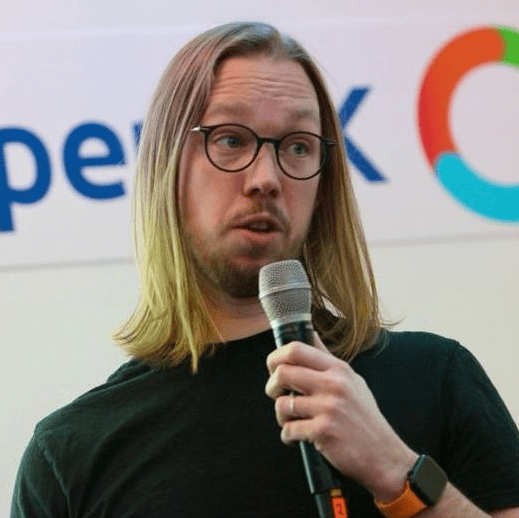
Join Viktor, a proud nerd and seasoned entrepreneur, whose academic journey at Santa Clara University in Silicon Valley sparked a career marked by innovation and foresight. From his college days, Viktor embarked on an entrepreneurial path, beginning with YippieMove, a groundbreaking email migration service, and continuing with a series of bootstrapped ventures.
Links


Follow Me


Follow Me
Join Viktor, a proud nerd and seasoned entrepreneur, whose academic journey at Santa Clara University in Silicon Valley sparked a career marked by innovation and foresight. From his college days, Viktor embarked on an entrepreneurial path, beginning with YippieMove, a groundbreaking email migration service, and continuing with a series of bootstrapped ventures.
Leadership Coaching for Founders: Why Knowing Better Is Not Enough with Ed Ley


Most leadership advice assumes the problem is information, that a founder stuck in the same pattern has simply not been told the right thing yet. The more interesting question is why capable people who already know what they should be doing carry on doing something else. I’m joined by Ed Ley, a leadership coach, author, former gym owner and two-time TEDx speaker, to explore why burnout is rarely a workload problem, what happens when a leader becomes the source of certainty for everyone around them, and how small changes to identity and operating rhythm produce a very different leadership system.
Ed’s route into this work did not start in a boardroom. It started in fitness, where results are hard to hide and the gap between intention and reality shows up quickly. One of his early answers came from a doctor’s surgery, where a doctor handed him the twenty percent of patients taking up eighty percent of his time. They had been told for years to move more and eat better, and the advice had never landed. Ed did not tell them again. He asked them to photograph what they ate, and that one act exposed the distance between the story people held about their habits and what was actually happening. Later, working in Bristol around both high-performance sport and business, he found a useful comparison: athletes and business leaders both commit heavily, but athletes respect recovery and timing in a way business leaders often do not.
The idea underneath his work is that most people do not need another generic plan. They need to understand the recipe they are already running. Every outcome has a process behind it, even when that process is unconscious, so the first job is not to prescribe a better routine but to map the existing one clearly enough that someone can see what is producing the current result. That is where the approach parts company with ordinary goal-setting. Rather than treating the brain as a rational machine that needs a destination and a few next steps, Ed treats it as a survival machine reacting to threat, prediction gaps and uncertainty. If it believes a step is dangerous, socially risky or likely to fail, it resists, even when the logic of the plan is sound.
The heart of the conversation is burnout, and the distinction Ed draws is worth holding onto. Burnout is not always caused by working too many hours. In leadership it often comes from being the person everyone depends on for certainty. A founder usually has the clearest view of the vision, the product direction and the tradeoffs, and at first that clarity is an advantage. Over time it becomes structural, because everyone starts routing decisions through the founder. Ed describes it as a bungee cord effect, with the leader tied to too many people who keep bouncing back for input or reassurance. The standard advice is to delegate more and rest more, which may be true but is rarely the first useful intervention. Nobody micromanages for fun. Leaders hold on because they are making predictions: that delegating means it comes back broken, that stepping away leaves the team without direction, that not answering stalls something important. So Ed looks at the prediction underneath the behavior rather than the behavior itself. Temporal discounting does the rest, and a leader normalizes a bad operating model because the immediate cost of changing it feels higher than the future cost of keeping it. The same logic shows up in habits: committing to a morning workout is a weak fix when the real blocker is a laptop open until eleven at night and a day with no protected focus window. His example of a CEO who moved from three and a half hours of sleep a night with chronic pain to a steady seven and a half shows how much shifts when the operating pattern is addressed rather than patched with advice.
What makes this difficult is that the problem is neither purely personal nor purely organizational. Founders often build the system that later traps them, because the clarity, grit and tolerance for ambiguity that made the company work are the same traits that make everyone else dependent on them. For anyone building scalable systems the lesson is familiar: bottlenecks are rarely solved by asking the bottleneck to work harder. You change the architecture. That means distributing clarity, setting decision boundaries, designing recovery into the operating cadence, and noticing when your identity has become attached to being the person who always has the answer.
For founders and engineering leaders, this episode reframes coaching as system design rather than self-improvement. The work is not becoming a different kind of person. It is understanding the system you are already running, then changing the smallest practical pieces that let you lead with more clarity, more trust and less friction.
Links
Found an error or typo? File PR against this file.