
Podcast
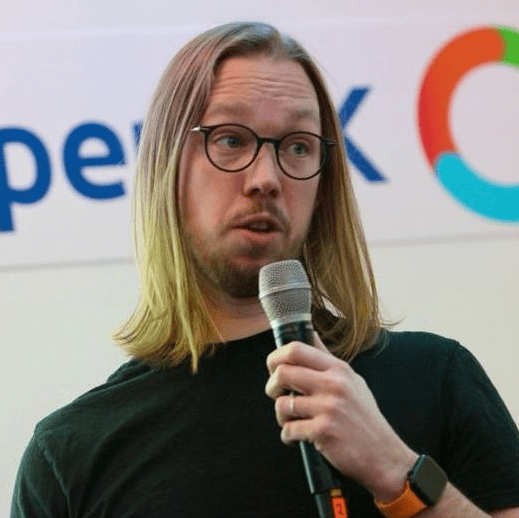
Join Viktor, a proud nerd and seasoned entrepreneur, whose academic journey at Santa Clara University in Silicon Valley sparked a career marked by innovation and foresight. From his college days, Viktor embarked on an entrepreneurial path, beginning with YippieMove, a groundbreaking email migration service, and continuing with a series of bootstrapped ventures.
Links


Follow Me


Follow Me
Join Viktor, a proud nerd and seasoned entrepreneur, whose academic journey at Santa Clara University in Silicon Valley sparked a career marked by innovation and foresight. From his college days, Viktor embarked on an entrepreneurial path, beginning with YippieMove, a groundbreaking email migration service, and continuing with a series of bootstrapped ventures.
Sovereign AI: Building Compute Where the Power Is with Peter Damm


The UK pays offshore wind operators around three billion a year to switch their turbines off, while AI companies struggle to find power for the GPUs they have already bought. That gap says a lot about where the next phase of AI will be decided. I’m joined by my good friend Peter Damm, or Pete, co-founder of Granite, a European company building infrastructure for sovereign AI, to explore where compute should actually live, who gets to control it, and why the smartest model does not automatically win.
Pete and I first got to know each other as neighbors in London, within walking distance, which is rare in a city where everything is 45 minutes away. He came to infrastructure through operating and investing rather than engineering. He helped build a B2B SaaS company through to an exit, then moved into investing in emerging tech through a fund and a venture studio. What drew him to energy and compute is a bottleneck that is getting harder to ignore. Data center builds in the US are being delayed or cancelled, even in friendly states like Texas, partly because early builds ignored local communities and partly because huge GPU clusters need more power in one place than the grid can supply. China builds new energy quickly. The US and Europe do not. A conventional data center takes five to seven years once planning and permits are included. Granite starts from the other end: find the stranded energy, then bring the compute to it.
The thinking behind Granite runs through three stages of cloud. Hyperscalers carry twenty years of patches and fixes that make them inefficient for AI. The neoclouds stripped those layers away and sold bare metal for training and inference. The third stage is the agentic cloud. Agents need memory, storage, permissions and software that balances work across GPUs, CPUs, memory and storage, and that changes the hardware itself. At the height of training, clusters ran eight GPUs for every CPU. That ratio is flipping toward eight CPUs for every GPU, and inference may be only a tenth of an agentic workload. Granite packages this into shipping-container-sized modular data centers with liquid cooling and no separate water supply, plus single-rack sovereign pods for offices or telco towers. Clients can order a container full of Nvidia GB300s for inference or one built purely for storage, while Granite’s own builds stay hardware agnostic, testing AMD and Dutch inference chipmaker Axelera alongside Nvidia. A unit deploys in about four months, and Granite has identified over 200 megawatts of sites in Europe.
Sovereignty here is not mainly about regulation, data protection or the US Cloud Act. It is about control. Closed models from OpenAI and Anthropic are permission models, so access can be switched off or repriced overnight. One AI-native startup woke up to a 30% increase, and I expect future hikes to be much larger, because we are in a subsidized phase much like early Uber and token-based pricing is not sustainable. Cost is the other half of the problem. Agents are non-deterministic, which makes products hard to price and budgets hard to set. Salesforce has struggled to price its agentic products, and Uber burned through its AI budget in the first quarter of 2026. Granite’s agentic operating system routes work between models and forecasts cost before a workload runs, reaching frontier-quality results from mid-tier models at 700 tokens per second on RTX 6000 cards.
Open models are what make this approach viable, now that Kimi scores at the same frontier level as the top closed models. The fear around Chinese open models is overblown. Open weights can be audited and adapted, while closed models cannot. Calling any provider’s API, Chinese or American, sends your data to that provider, so running the weights yourself is what keeps it sovereign. The AI doom narrative deserves the same scrutiny. A warning that there is a 10% chance the world ends reads either as a lab believing its own hype or as a play for regulatory capture, and restricting who can build models would create exactly what people fear: centralized AI controlled by a few.
The harder problem is the habits around the technology. We are in the YOLO era of agents, where people hand a tool their inbox, password vault and bank details and hope for the best. At Screenly we receive AI-written vulnerability reports every day. Denmark recently leaked 8.8 million social security numbers in a country of about 6 million people, covering the living and the dead, and only noticed because of an unusually large bill for collecting the data. Security is becoming agents against agents, and defenders need systems that repair themselves. Granite applies this to its own sites with a lightweight, stateless operating system that can be rebooted remotely, and erasure-coded storage with about 20% overhead instead of the four copies traditional providers keep. We close on a question inspired by Satya Nadella: like the railroads or Netscape, could OpenAI and Anthropic help build a revolution and not survive it? It is a trillion-dollar question, and the more interesting one may be whether today’s LLMs lead to AGI at all.
For founders and engineering teams building on AI, the takeaway from this episode is practical: keep your architecture portable across models, know what your agent workloads cost before you ship, give each agent only the permissions one task needs and never the raw keys, and treat sovereign AI as a design decision you make now rather than a migration forced on you later.
Links
- Granite - Sovereign AI infrastructure and the agentic cloud
Found an error or typo? File PR against this file.